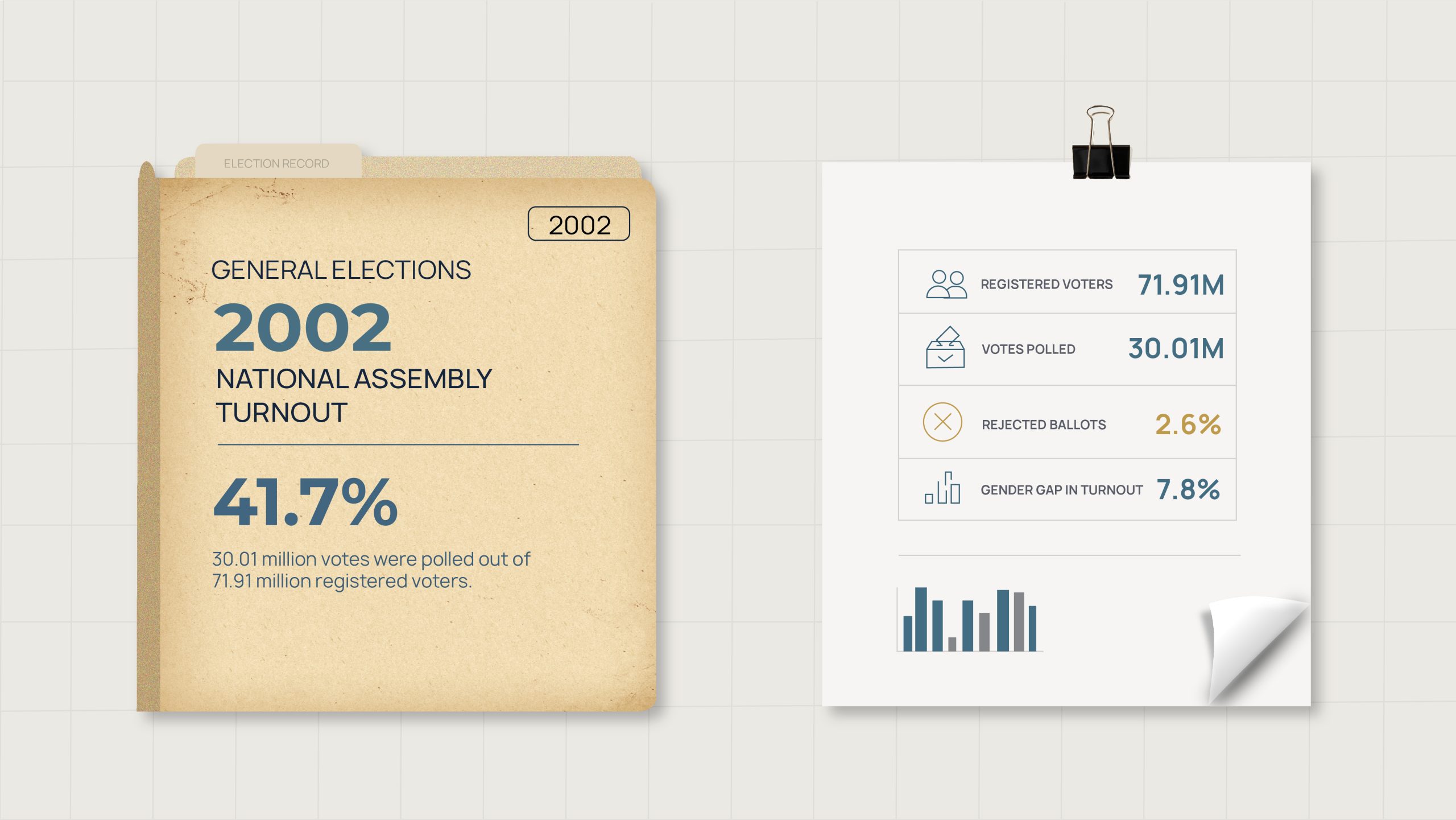
A total of 30.01 million votes were polled for the National Assembly in the General Elections, 2002, out of 71.91 million registered voters, recording a turnout of 41.7%.
The 2002 general elections were held on 10 October 2002 under the military government of General Pervez Musharraf, following his October 1999 coup against Prime Minister Nawaz Sharif. The elections were held under a Legal Framework Order (LFO) that introduced significant constitutional changes, including reserving seats for women and technocrats. The Pakistan Muslim League (Q) — widely described as a pro-establishment party — emerged as the largest single party.
Of the 71.91 million registered voters, 38.75 million — 53.9% — were male and 33.16 million — 46.1% — were female. The gender gap in voter registration stood at 5.59 million, representing 7.8% of the total registered electorate.
At the National Assembly level, 30.01 million votes were polled against a registered electorate of 71.91 million, producing an overall turnout of 41.7%. This figure reflects votes cast across all National Assembly constituencies in the four provinces, Islamabad Capital Territory, and — from 2002 onwards — the Federally Administered Tribal Areas (FATA), which were subsequently merged into Khyber Pakhtunkhwa through the Twenty-Fifth Constitutional Amendment in 2018.
Gender-disaggregated data on votes polled are not available for the 2002 elections. The systematic disaggregation of votes polled by sex was not incorporated into election administration and result-reporting frameworks prior to the 2018 elections.
Of the votes polled at the National Assembly level, 775,720 ballots — 2.6% of total votes cast — were declared rejected or invalid. Rejected ballots include votes cast on incorrect ballot papers, those on which no mark was made, those bearing marks on multiple candidates, and those bearing marks that could not be attributed to a valid candidate. The rejection rate is a measure of the quality of voter instruction and the accessibility of the ballot design across the electorate.
Across all five assembly elections conducted concurrently in 2002, Punjab recorded the highest absolute number of votes polled, consistent with the province’s share of the national registered electorate. Khyber Pakhtunkhwa and Balochistan returned lower absolute polling figures, in proportion to their smaller registered electorates.
FAFEN’s analysis of Pakistan’s twelve general elections between 1970 and 2024 situates the 2002 National Assembly turnout of 41.7% within the broader trend of participation rates. The highest recorded National Assembly turnout across this period was 54.9% in 2013. The lowest was 34.8% in 1997.