With reports suggesting that the upcoming 27th Constitutional Amendment may return education sector to federal control from provinces, it is timely to examine the state of education in Pakistan. FAFEN has dug into data from the reports published by the Pakistan Institute of Education (PIE), a government organization under the Ministry of Federal Education and Professional Training, to understand where the provinces and Islamabad Capital Territory stand in terms of school education.
What are the constitutional guidelines on education?
Article 25-A of the Constitution mandates the state to provide free and compulsory education to all children between the ages of five and 16. This Article was added to the Fundamental Rights chapter in the Constitution under the Eighteenth Constitutional Amendment in 2010. Since then, all provinces and ICT have legislated on free and compulsory education to give effect to this constitutional mandate.
How much do we spend on education?
Public spending on education has been dwindling in Pakistan over recent years. It stood at two percent of the Gross Domestic Product (GDP) in 2018-19 but has come down to 1.5 percent in 2022-23, which is around 1.37 trillion Rs in terms of money. Therefore, this much money would go to the federal pool if the devolution of education to the provinces were reversed.
According to the Public Financing in Education 2022-23 report by PIE, Khyber Pakhtunkhwa allocated the largest share of its budget to education at 25 percent in 2022-23, followed by Balochistan (16 percent). Punjab and Sindh each allocated around 13 percent of their provincial budgets to the sector.
Punjab’s allocations for education in provincial budget has declined from 20 percent in 2018-2019 to 13 percent in 2022-23; Sindh from 18 percent to 14 percent; Khyber Pakhtunkhwa from 25 percent to 27 percent; and Balochistan from 18 percent to 16 percent. ICT’s education budget has come down from four percent in 2019-2020 to three percent in 2022-23.
In terms of budget utilization, Punjab (99 percent), Balochistan (96 percent), and Sindh (93 percent) utilized most of their allocated budgets, while Khyber Pakhtunkhwa spent 82 percent of its allocation.
How many children are out of school in Pakistan?
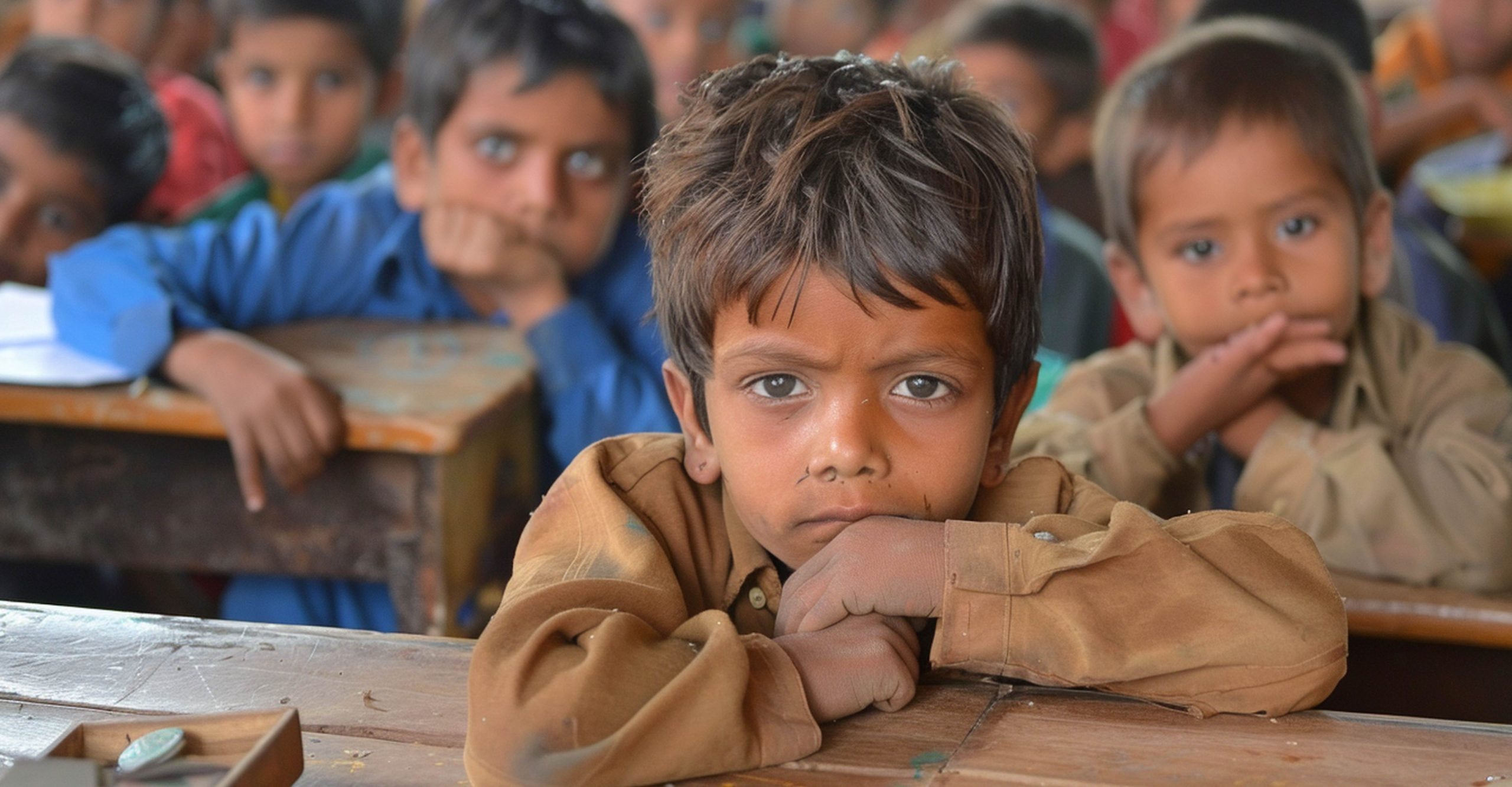
Pakistan has over 71 million children aged between five and 16, according to the 2023 census. Pakistan Education Statistics 2023-2024 (PES 2023-24) by PIE reveals that more than one-third (25.15 million or 35 percent) of these school-age children remain out of schools.
The highest proportion of out-of-school children is in Balochistan, where two-thirds of children are not enrolled. It is followed by Sindh (44 percent), Khyber Pakhtunkhwa (34 percent), Punjab (27 percent), and Islamabad Capital Territory (15 percent).
How many schools do we have?
According to PES 2023-24, there are over 225,000 schools across the country, with around 56 percent of these being primary schools, while 40 percent are middle or high schools, and four percent are higher secondary schools. By gender, 48 percent of schools cater to boys, 36 percent to girls, and 16 percent are co-educational.
In terms of availability, Balochistan has the highest number of schools relative to its student population, with more than three schools per 1,000 students, followed by Khyber Pakhtunkhwa (2.65) and Sindh (2.60). Punjab (1.73) and Islamabad (0.73) have the lowest school availability per 1,000 students.
What is the state of facilities in schools?
Not all of the abovementioned schools have access to facilities. Nationally, only 47 percent of schools have electricity, drinking water, toilets, boundary walls, and satisfactory building conditions.
Punjab leads with 74 percent of schools having the basic infrastructure, followed by Islamabad Capital Territory (72 percent) and Khyber Pakhtunkhwa (68 percent). On the other hand, Sindh and Balochistan lag behind significantly, with only eight percent and 2.7 percent of the schools with access to essential facilities, respectively.
How many teachers are there in the schools?
The country’s cumulative teaching workforce is over 1.8 million. This means there is one teacher for every 39 children in the 71 million school-age population. However, this teacher availability also varies widely across regions. Balochistan has the lowest teacher availability, with one teacher for every 71 school-age children. Islamabad fares the best, with one teacher for every 17 children. Punjab and Khyber Pakhtunkhwa each have roughly one teacher per 37 to 38 children, while Sindh has one per 40.