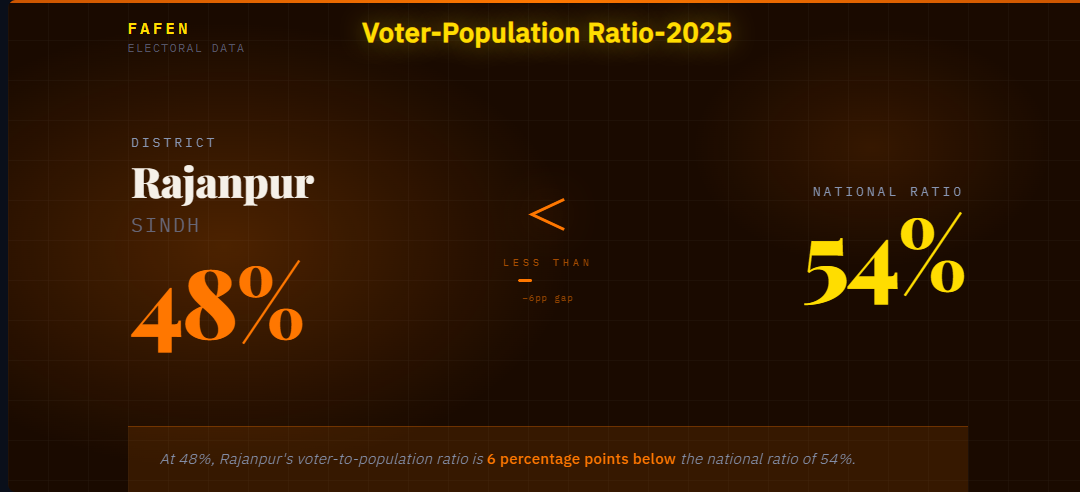
Rajanpur’s voter registration rate stands at 48% of its estimated 2025 population — six percentage points below the national ratio of 54%.
Methodology
These figures are drawn from district-wise electoral roll statistics released by the Election Commission of Pakistan (ECP) on 30 December 2025. They are cross-referenced against population estimates derived from the 2023 Digital Census. The 2025 population estimate applies the 2.99% inter-censal annual growth rate to Rajanpur’s census base population of 2,381,049, yielding an estimated 2025 population of 2,525,564. Registration rates are calculated by dividing the number of registered voters by this estimated population.
Voter registration in Rajanpur
The district has 1.2 million registered voters — 648,914 males (54.0%) and 553,089 females (46.0%). Among males, 51% of the estimated population is registered; among females, 45%. Rajanpur ranks 33rd out of 136 districts nationally by population size and is represented by three Members of the National Assembly.
By voter registration rate, Rajanpur ranks 95th nationally and 36th of 36 within Punjab.
Why registration trails the national ratio
Rajanpur’s below-average registration rate reflects the census enumeration pattern seen in districts that receive in-migrants from smaller surrounding areas. In-migrants counted here at census time often retain voter registration in their origin locality.
This inflates the population denominator relative to the local voter roll, producing a registration ratio below the national average.
Female voters constitute 46.0% of the registered electorate, reflecting a moderate gender gap of 8.0%. Targeted registration outreach for women in Rajanpur should remain a priority before the next general elections.
This post is part of FAFEN’s series on voter vs population ratio. Read more of this series here.