The promise that “every vote counts” does not hold true under Pakistan’s electoral system, where a majority of votes cast in recent general elections have failed to translate into representation.
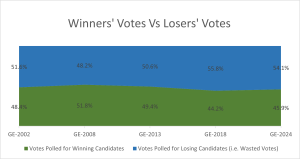
In the General Elections (GE) 2024, around 59.5 million votes were polled across the country. Of these, more than 32.2 million votes or 54 percent were cast in favor of losing candidates. For all practical purposes, those votes went to waste, as they did not contribute to electing any representative to the assemblies.
What are wasted votes?
Wasted votes are ballots cast for candidates who do not win a seat in their constituency. Under Pakistan’s First Past the Post (FPTP) system, a candidate only needs a simple majority to win — even if a large majority of voters supported others.
For instance, if 100 votes are cast in a constituency with 10 candidates, and Candidate A receives just 11 votes, he or she wins the seat. The remaining 89 votes (89 percent), though validly cast, make no impact on representation.
How many votes have we been wasting?
The number of wasted votes has risen consistently since 2002.
In GE-2002, a total of 29.2 million votes were polled, out of which 15.9 million or 52 percent went to losing candidates. Â GE-2008 had 34.6 million polled votes, with the number of wasted votes rising to 16.7 million. However, their proportion in the total votes slightly declined to 48 percent. In GE-2013, 45.7 million votes were polled, and 23.1 million or 51 percent went to losing candidates. Â In GE-2018, 53.1 million votes were cast, with the number of wasted votes surging to 29.6 million, representing 56 percent of the total, the highest in Pakistan’s recent electoral history.
Why is it concerning?
The phenomenon of wasted votes is a significant factor behind growing political polarization in Pakistan. Millions of citizens who actively participate in elections end up feeling betrayed as their voices have been disregarded. Such perceptions among the majority lead to weakening public faith in the political system.
As fifth-largest democracy by voter population, Pakistan urgently needs to confront this widening gap between voter intent and legislative representation. Unless the FPTP system is replaced or reformed into a more inclusive model, such as proportional representation, future elections may further alienate voters instead of empowering them.