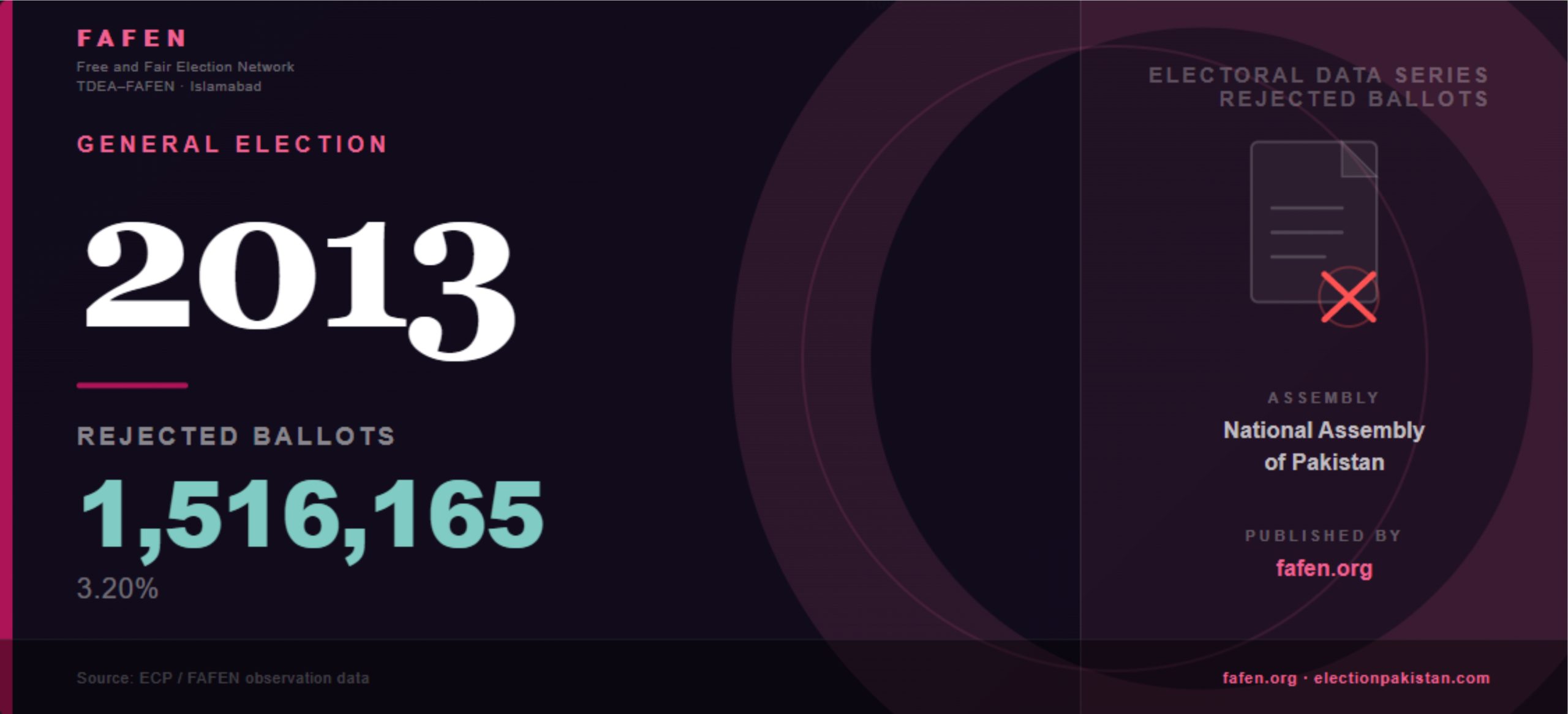
In the 2013 National Assembly election, 1,516,165 votes were rejected out of 47,312,148 polled — a rate of 3.20%. For the first time in this dataset, the nationwide combined total across all assemblies surpassed three million, reaching 3,102,016 rejected ballots. Balochistan recorded the highest provincial rate at 5.21%, and Sindh crossed four percent for the first time, reaching 4.05%. Khyber Pakhtunkhwa stood at 3.41% and Punjab at 3.12%.
Election Context: 2013
Pakistan’s 2013 general elections were held on 11 May 2013 and marked the country’s first democratic transfer of power from one elected government to another. The Pakistan Muslim League (Nawaz) won a majority and formed the federal government. FAFEN deployed more than 40,000 observers across the country. The sharp increase in absolute rejected ballots — from 1,976,390 in 2008 to 3,102,016 in 2013 — is partly attributable to the substantial increase in total votes polled, though rising percentage rates in Sindh and Balochistan indicate a pattern that extends beyond turnout alone.
Breakdown — Rejected Ballots
| Assembly | Rejected Ballots | Rejection Rate |
| National Assembly Election | 1,516,165 | 3.20% |
| Khyber Pakhtunkhwa Assembly Election | 189,725 | 3.41% |
| Punjab Assembly Election | 902,437 | 3.12% |
| Sindh Assembly Election | 422,863 | 4.05% |
| Balochistan Assembly Election | 70,826 | 5.21% |
Source: TDEA–FAFEN compiled dataset from Election Commission of Pakistan records.
What Is a Rejected Ballot?
A rejected or invalid ballot is a ballot paper that polling staff determine cannot be counted as a valid vote. Under Pakistani electoral procedure, a ballot is rejected if it does not bear the presiding officer’s official stamp and the Signature, if it bears any mark or writing other than the official seal and the signature of the Assistant Presiding Officer APO; if any extraneous paper or material is attached to it; or if the voting mark is affixed simultaneously in the boxes of two candidates bearing their respective election symbols in such a manner that it is not possible to determine with certainty for which candidate the vote has been cast. The rejection of a ballot does not automatically indicate fraud or deliberate misconduct. Voter error — including accidental double-marking or stamps placed outside designated boxes — accounts for a documented share of rejections in every election.